
Why Do I Overthink Everything? When Your Mind Won’t Let a Problem Go
Have you ever replayed a conversation in your head and suddenly thought of ten different things you should have said?
Maybe you sent a text and now you’re wondering why they haven’t responded. Did I say something wrong? Did they misunderstand me? Are they upset? Should I send another message?
Or maybe you’re trying to make a decision, but instead of feeling more certain the longer you think about it, you somehow end up with even more questions.
If this sounds familiar, you may have wondered: Why do I overthink everything?

“Overthinking” isn’t a clinical diagnosis. It’s an everyday term people often use to describe experiences such as persistent worry, rumination, or repetitive negative thinking. These patterns can occur alongside anxiety, but experiencing them doesn’t automatically mean you have an anxiety disorder.
Sometimes the more useful question isn’t “Why do I think so much?” but:
Is all this thinking actually helping me move forward?
When Thinking Turns Into Overthinking
Thinking things through isn’t a bad thing. Being thoughtful can help us solve problems, make decisions, prepare for difficult situations, and better understand our experiences.
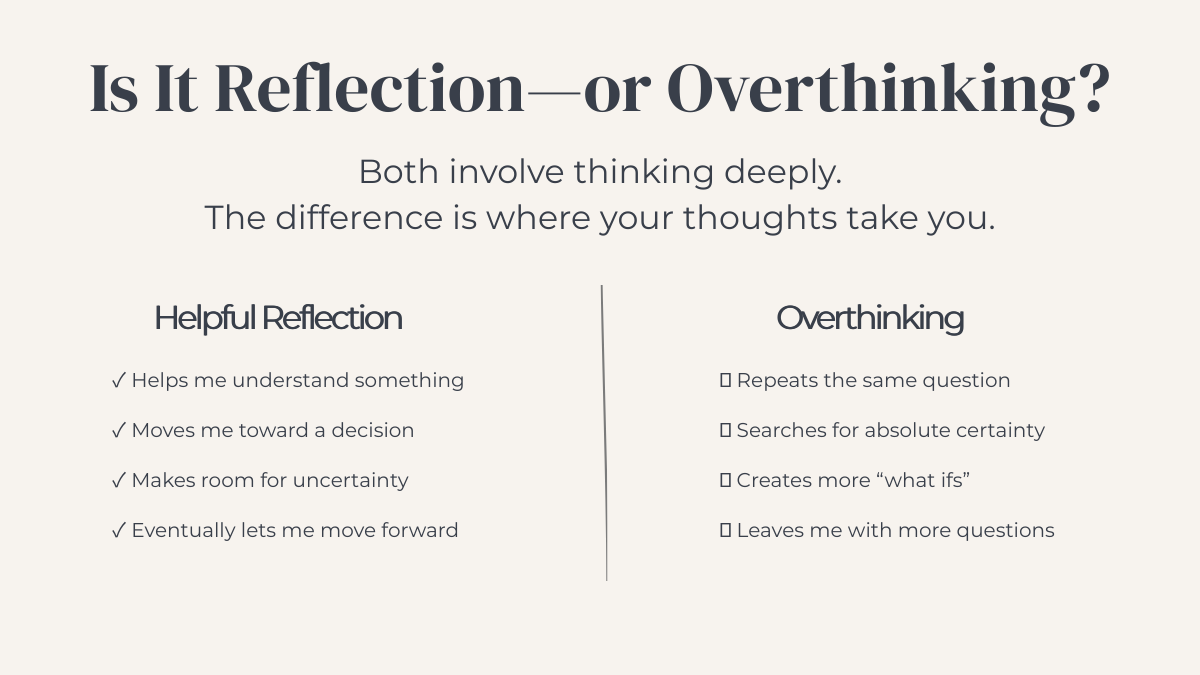
Helpful thinking usually moves toward something—a decision, an action, a new understanding, or even acceptance that you don’t have all the answers yet.
Overthinking tends to circle.
You may find yourself returning to the same questions:
What if I made the wrong decision?
What if something goes wrong?
Why did I say that?
What are they thinking about me?
What if I missed something?
You might even arrive at a perfectly reasonable answer, only for your mind to respond:
“Yeah…but what if?
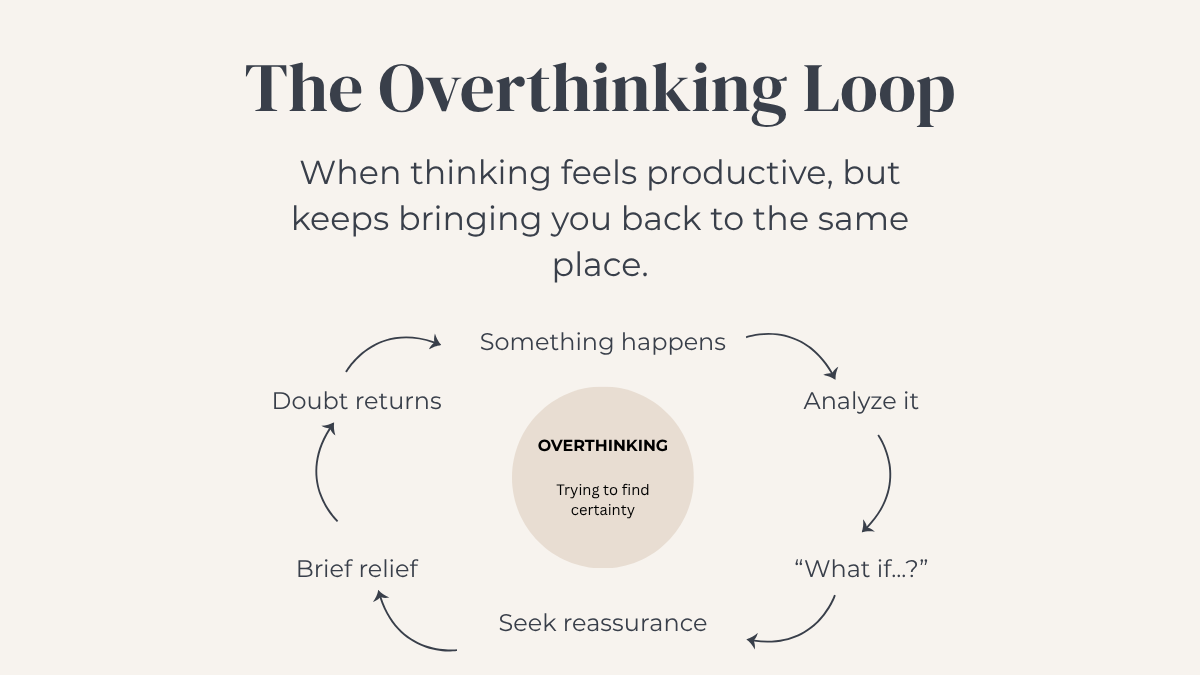
Research suggests that worry isn’t necessarily the same as productive problem-solving. In one experimental study, approaching a personal problem through worry was associated with poorer problem-solving outcomes than thinking about the problem more objectively (Llera & Newman, 2020).
So when you notice yourself going around in circles, try asking:
“Am I looking for a solution—or am I looking for certainty?”
Why Uncertainty Can Keep the Loop Going
That distinction matters because worry and difficulty tolerating uncertainty are closely connected.
Researchers use the term intolerance of uncertainty to describe difficulty with not knowing what might happen. Research has found a substantial relationship between intolerance of uncertainty and worry, although this pattern isn’t exclusive to any one mental health diagnosis (Gentes & Ruscio, 2011).
Imagine sending an important email.
You write it. Proofread it. Check the recipient. Check the attachment. Read it once more and finally hit send.
Done, right?
Except another round begins.
Was that sentence too direct?
What if they misunderstood me?
Why haven’t they responded yet?
Nothing new has necessarily happened. But your mind is already trying to solve several possible futures.
Sometimes all that mental preparation may function like an attempt at protection: If I can anticipate every possibility, maybe I won’t be caught off guard.
The difficulty is that life rarely gives us complete certainty.
What Can I Do When I’m Stuck in an Overthinking Loop?
You don’t have to solve overthinking by thinking even harder. Instead, experiment with changing how you respond when you notice the loop.
Name what’s happening. Try telling yourself, “I’ve already answered this question. My mind is asking me to answer it again.” You don’t have to argue with the thought. You’re simply noticing what’s happening.
Look for an actionable problem. Ask, “Is there something useful I can do right now?” If there is, identify a reasonable next step. If there isn’t, continuing to think may not give you new information.
Decide what “enough” looks like. Maybe you’ll compare three options instead of twenty, proofread the email twice instead of ten times, or give yourself a reasonable amount of time to consider a decision before stepping away.
Come back to the present. Overthinking can pull you backward—Why did I do that?—or forward—What if this happens? Try bringing some attention back to what is actually happening around you right now.
Practice allowing some uncertainty. Sometimes the most accurate answer really is:
“I don’t know yet.”
That doesn’t mean you don’t care. It means you’re recognizing that not every uncertainty can be solved in advance.

Why “Just Stop Overthinking” Usually Doesn’t Help
If stopping were that simple, you probably would have done it already.
Trying to force unwanted thoughts away doesn’t necessarily make them disappear. Research on thought suppression has found that suppressed thoughts can sometimes become more accessible afterward—a phenomenon known as a rebound effect (Abramowitz et al., 2001).
Instead of treating every thought as something that needs to be eliminated or solved, it may help to remember:
A thought doesn’t always need an answer.
A worry doesn’t always need a solution.
And something being possible doesn’t necessarily mean it’s probable.
When Overthinking Starts Taking Up Too Much Space
Most of us overthink from time to time. A stressful day, an important decision, relationship conflict, or uncertainty about the future can send almost anyone into their head for a while.
The National Institute of Mental Health notes that occasional anxiety is a normal part of life. Anxiety becomes more concerning when it persists and begins interfering with everyday activities.
It may be worth paying closer attention if worry or repetitive thinking regularly interferes with your sleep, concentration, decision-making, relationships, or ability to stay present in everyday life.
At that point, the question may become less about:
“How do I stop thinking so much?”
and more about:
“What is all this thinking trying to help me manage?”
That can be an important question to explore.
How Therapy Can Help With Overthinking
Therapy isn’t about learning how to have an empty mind. And a therapist isn’t simply going to tell you to “stop worrying.”
Instead, therapy can provide space to become curious about what’s underneath all that thinking.

You might explore why uncertainty feels particularly uncomfortable, what happens when you think you’ve made a mistake, why someone’s disappointment or disapproval feels difficult to tolerate, or why being prepared and in control feels so important.
Depending on what keeps the pattern going, therapy may also help you recognize how you respond to worry and develop different ways of approaching uncertainty.
At Therapy Center of Houston, our approach is personalized to each client. Our practice offers several therapeutic approaches, including CBT, Internal Family Systems (IFS), EMDR, Polyvagal-Informed Therapy, and Psychodynamic Therapy.
If anxiety, racing thoughts, or persistent worry are taking up more space in your life than you’d like, you can learn more about our anxiety counseling in Houston.
Final Thoughts
If you’re someone who overthinks, you may have spent a lot of time wishing you could simply turn your brain off.
But the goal doesn’t have to be to stop thinking.
It may be learning to recognize when your thinking is helping you—and when your mind is searching for a level of certainty that life simply can’t provide.
The next time you notice yourself replaying a conversation, imagining every possible outcome, or asking yourself the same question for the tenth time, try asking:
“Is there something useful for me to do right now—or is my mind asking me for certainty I can’t have yet?”
Sometimes, “I don’t know yet” really is enough.

If persistent worry or overthinking is making it difficult to feel present in your everyday life, support is available.
Therapy Center of Houston offers therapy at our Montrose office in Houston as well as virtual sessions.
You can contact Therapy Center of Houston or call or text (713) 807-7518 to explore whether therapy may be a good fit for you.
References
Abramowitz, J. S., Tolin, D. F., & Street, G. P. (2001). Paradoxical effects of thought suppression: A meta-analysis of controlled studies. Clinical Psychology Review, 21(5), 683–703. https://doi.org/10.1016/S0272-7358(00)00057-X
Gentes, E. L., & Ruscio, A. M. (2011). A meta-analysis of the relation of intolerance of uncertainty to symptoms of generalized anxiety disorder, major depressive disorder, and obsessive-compulsive disorder. Clinical Psychology Review, 31(6), 923–933. https://doi.org/10.1016/j.cpr.2011.05.001
Llera, S. J., & Newman, M. G. (2020). Worry impairs the problem-solving process: Results from an experimental study. Behaviour Research and Therapy, 135, 103759. https://doi.org/10.1016/j.brat.2020.103759