
High-Functioning Anxiety: When You Look Fine but Don’t Feel Fine
You show up.
You meet the deadline. Answer the email. Remember the appointment. Take care of what needs to be done.
From the outside, you may even look like someone who has it all together.
But inside?
Your mind rarely stops.
You’re thinking about what you forgot, what could go wrong, whether you did enough, and what you need to do next. Rest can feel uncomfortable. Mistakes feel bigger than they probably are. And even when someone tells you that you’re doing a great job, part of you may wonder how long you can keep it all up.
Sometimes anxiety doesn’t look the way we expect it to.

What Is High-Functioning Anxiety?
“High-functioning anxiety” isn’t a formal mental health diagnosis. Instead, it’s a phrase people often use to describe an experience in which anxiety is present even though a person continues to function well—or appears to—from the outside.
Someone experiencing this pattern may be successful at work, dependable in relationships, involved with family, and generally able to manage everyday responsibilities.
That doesn’t mean those things feel easy.
You might prepare excessively because you’re afraid of getting something wrong. You may arrive early because being late feels unbearable. You might reread an email several times before sending it or push yourself to finish something perfectly because “good enough” doesn’t feel safe.
Those behaviors can look like responsibility or ambition.
And sometimes they are.
The question is: What is driving them, and what is it costing you?
Research supports an important distinction here. Perfectionistic concerns—such as being highly concerned about mistakes or feeling pressure to meet expectations—are associated with anxiety and psychological distress. Simply having high standards or wanting to do well is not the same thing (Callaghan et al., 2024).
Signs Anxiety May Be Hiding Behind “Having It Together”
Anxiety can look different from person to person. You may not identify with every experience, but some patterns can include:
Constantly thinking ahead or anticipating problems
Having difficulty saying no or disappointing people
Setting very high expectations for yourself
Replaying conversations or decisions afterward
Feeling guilty when you aren’t being productive
Overpreparing for situations that other people seem to take in stride
Needing reassurance that you did something correctly
Procrastinating because you’re afraid of doing something imperfectly
Feeling physically tense even when nothing seems obviously wrong
Struggling to relax because your mind immediately moves to the next task
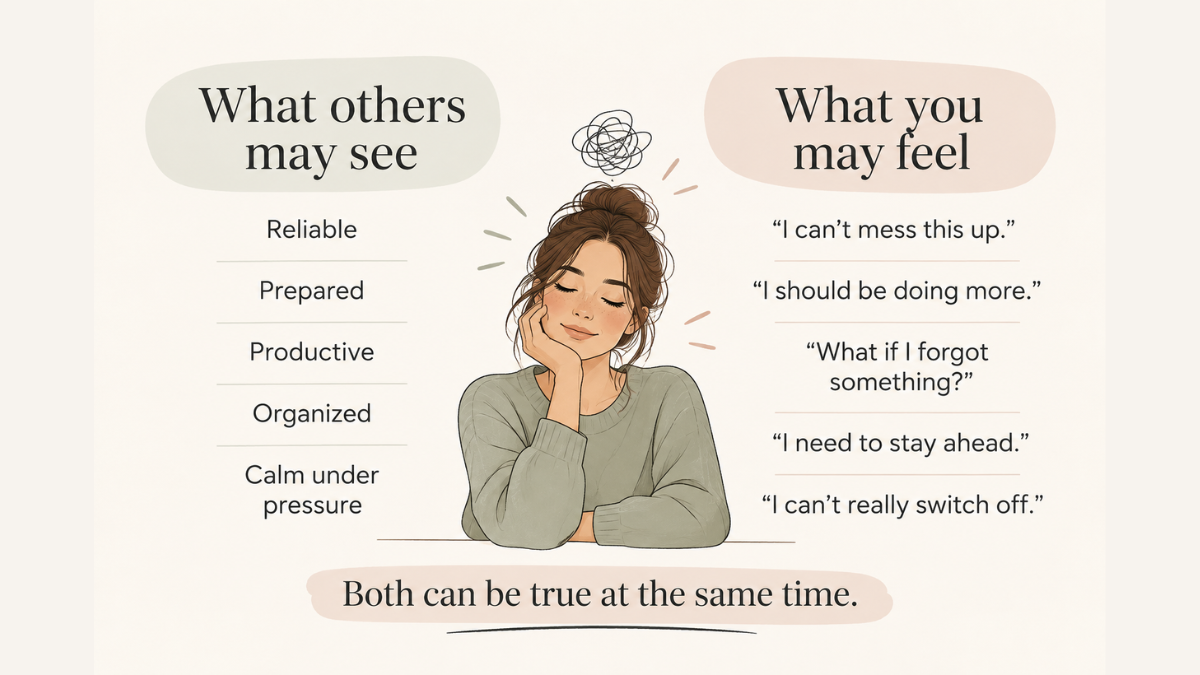
These experiences by themselves don't establish an anxiety disorder. Anxiety becomes more clinically concerning when it is persistent, difficult to control, distressing, or begins interfering with everyday life. NIMH notes that anxiety can involve excessive worry, restlessness, difficulty relaxing, problems concentrating, sleep difficulties, and physical tension.
Sometimes there is an interesting contradiction here.
Other people may describe you as organized, dependable, calm, hardworking, or successful.
Meanwhile, your internal experience may sound more like:
Don’t mess this up.
You should be doing more.
What if you forgot something?
Everyone else seems to handle this better than you.
You can rest after everything is done.
Except somehow, everything is never completely done.
When Anxiety Gets Praised
One reason these patterns can be difficult to recognize is that some of the behaviors associated with them may also be rewarded.
Double-checking your work can make you thorough.
Fear of disappointing someone can make you work harder to be dependable.
Worrying about failure can push you to prepare.
High standards can sometimes contribute to impressive results.
So if those behaviors have helped you succeed, why would you question them?
Because something can look productive from the outside while still carrying a significant internal cost.
Research on perfectionism helps explain why this distinction matters. Perfectionistic concerns show stronger associations with anxiety and distress than simply striving to do well (Callaghan et al., 2024). Other research has also linked concern over mistakes and doubts about one's actions with later anxiety symptoms, although these relationships are modest and do not mean perfectionism inevitably causes anxiety (Smith et al., 2018).
There is a difference between working hard because something matters to you and feeling like you have to keep working because slowing down makes you anxious.
There is a difference between wanting to do something well and feeling that making a mistake says something terrible about who you are.
And there is a difference between being dependable and believing you can never let anyone down.
“But I’m Still Functioning. Is It Really Anxiety?”
It can be easy to minimize what you’re experiencing when you compare yourself to someone who seems to be struggling more visibly.
You may think:
I’m still going to work.
I’m taking care of my family.
I’m getting things done.
Other people have it worse.
But functioning and feeling well are not the same thing.
You don’t have to use someone else’s level of distress as the measure for whether your own experience deserves attention.
Sometimes a more useful question than “Am I functioning?” is:
“How much effort does it take for me to keep functioning this way?”
And perhaps:
“What is all of this pressure costing me?”
Those questions can tell you quite a bit.
What Happens When You Finally Slow Down?
For some people, staying busy can make it easier not to notice worry until things become quiet.
As long as there is another task to complete, another problem to solve, or another person to take care of, there may not be much room to notice what’s happening internally.
Then the day gets quiet.
You finally sit down.

And instead of feeling relieved, you feel restless.
Your mind starts reviewing the day. Your body still feels tense. You remember three things you need to do tomorrow. Maybe you reach for your phone, open your email again, or find another task.
If rest makes you uncomfortable, that doesn’t necessarily mean you’re “bad at relaxing.” For some people, slowing down simply makes worry, tension, or thoughts that were easier to overlook while busy more noticeable.
Research on chronic worry also suggests that staying mentally prepared for something negative can sometimes feel protective. In studies of people with generalized anxiety disorder, worry appears to help some people avoid the uncomfortable emotional shift of moving suddenly from feeling relatively calm to feeling distressed (Llera & Newman, 2014). That doesn’t mean worrying prevents bad things from happening—but it may help explain why letting go of worry can sometimes feel surprisingly difficult.
A Few Things You Can Try
If some of this feels familiar, you don’t have to completely change your personality or stop being ambitious, organized, or responsible.
The goal isn’t to care less.
It may be learning to notice when healthy responsibility starts turning into anxiety-driven pressure.
Notice the pressure behind your actions.
When you find yourself checking, preparing, fixing, or pushing harder, ask:
“What am I afraid would happen if I didn’t do this perfectly?”
Experiment with “good enough” in low-stakes situations.
You might send a casual text without rewriting it several times, finish a small task without repeatedly checking it, or allow someone else to handle something differently than you would.
This idea is consistent with cognitive-behavioral approaches to problematic perfectionism, which can include behavioral experiments examining repeated checking, rigid standards, self-criticism, and beliefs about mistakes.
Notice how you respond to mistakes.
If a small mistake immediately becomes I should have known better or I always mess things up, consider how you would respond if someone you cared about made the same mistake.
Research on self-compassion interventions suggests they may help reduce anxiety symptoms, although results vary across interventions and populations (Luo et al., 2023).
These are small experiments, not tests you have to pass. The point is to begin noticing the difference between choosing to be responsible and feeling unable to stop pushing yourself.

When Therapy May Help
Therapy can provide a place to explore what keeps worry and pressure going beneath the surface.
Maybe being prepared has become closely connected with feeling safe. Maybe achievement has become tied to how you evaluate yourself. Perhaps disappointing someone feels especially uncomfortable, or uncertainty makes you feel as though you need to work harder to prevent something from going wrong.
You don’t have to know exactly where those patterns come from before starting therapy.
And you don’t have to wait until you reach a breaking point to talk about them.
Professional support may be worth considering when anxiety is persistent, difficult to manage, or begins affecting sleep, relationships, concentration, work, or your ability to enjoy everyday life.
At Therapy Center of Houston, we work with adults experiencing anxiety, perfectionism, chronic worry, and patterns that can make it difficult to slow down or feel at ease—even when life looks perfectly fine from the outside.
Final Thoughts
Sometimes the person who looks like they have everything under control is working incredibly hard to feel that way.
If that sounds familiar, being able to keep functioning doesn’t mean you have to ignore what the experience is costing you.
You can be capable and overwhelmed.
Successful and anxious.
Grateful for your life and tired of carrying so much internal pressure.
Getting support doesn’t mean giving up the parts of you that are driven, thoughtful, or responsible.
It may simply help you find ways for those parts of you to stop having to work quite so hard.

If anxiety, perfectionism, or constant pressure is making it difficult to feel at ease, Therapy Center of Houston offers anxiety therapy for adults in Houston and through virtual sessions.
You can contact Therapy Center of Houston or call or text (713) 807-7518 to explore whether therapy may be a good fit for you.
References
Callaghan, T., Greene, D., Shafran, R., Lunn, J., & Egan, S. J. (2024). The relationships between perfectionism and symptoms of depression, anxiety and obsessive-compulsive disorder in adults: A systematic review and meta-analysis. Cognitive Behaviour Therapy, 53(2), 121–132. https://doi.org/10.1080/16506073.2023.2277121
Llera, S. J., & Newman, M. G. (2014). Rethinking the role of worry in generalized anxiety disorder: Evidence supporting a model of emotional contrast avoidance. Behavior Therapy, 45(3), 283–299. https://doi.org/10.1016/j.beth.2013.12.011
Luo, X., Che, X., & Lei, Y. (2023). Characterizing the effects of self-compassion interventions on anxiety: Meta-analytic evidence from randomized controlled studies. Journal of Contextual Behavioral Science, 30, 132–141. https://doi.org/10.1016/j.jcbs.2023.10.004
Smith, M. M., Vidovic, V., Sherry, S. B., Stewart, S. H., & Saklofske, D. H. (2018). Are perfectionism dimensions risk factors for anxiety symptoms? A meta-analysis of 11 longitudinal studies. Anxiety, Stress, & Coping, 31(1), 4–20. https://doi.org/10.1080/10615806.2017.1384466